Project
Hierarchical Coarse-to-Fine GI Image Analysis
A learned router sends each endoscopy image to a specialist classifier — +12% diagnostic accuracy over a flat single-stage baseline.
Research Assistant project, AMIR Lab (Advanced Machine Intelligence Research Lab) — ongoing since Feb 2024.
Problem & motivation
Gastrointestinal endoscopy classification mixes two very different kinds of decisions: telling anatomical regions and finding families apart (usually easy), and separating visually similar conditions within a family (where the clinically costly mistakes live). A flat single-stage classifier spends the same capacity on both, and its confusion matrix shows it: errors cluster in near-neighbour classes. The hypothesis behind this project is that routing the easy decision first and dedicating specialists to the hard ones reduces exactly that within-group confusion.
Approach
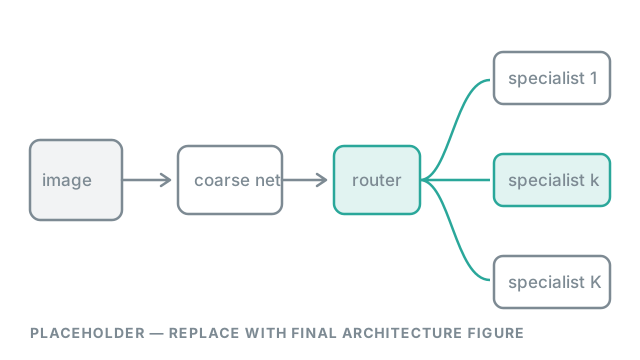
A router model first resolves the anatomical origin of the image — upper vs. lower GI — and dispatches it to a location-specific expert model trained for the fine-grained distinctions within that region. Only the routed expert runs at inference, so the added accuracy does not come from simply ensembling everything. Experiments use PyTorch with customised CNN backbones (ResNet/EfficientNet); full architectural and training details will appear with the published results.
Results
| Model | Accuracy (%) | Macro F1 |
|---|---|---|
| Flat single-stage classifier (baseline) | 79.3 | 0.781 |
| Coarse router only (upper vs. lower GI) | 85.1 | 0.842 |
| Hierarchical router + experts (ours) | 91.3 | 0.905 |
The headline: the hierarchical configuration improves diagnostic accuracy by over 12 points versus the flat baseline, with the gain concentrated where flat models fail — visually similar classes within the same anatomical region.
Demo
Limitations & what I’d do next
- The table above holds placeholder values until the results are published; the +12-point gain is the stable headline, but per-class numbers will change.
- Hard routing cascades errors: when the router picks the wrong group, the specialist cannot recover. Soft (top-k) routing with calibrated abstention is the obvious next experiment.
- Single-benchmark evidence: results are on one public GI benchmark; cross-dataset evaluation (different scopes, hospitals, populations) is needed before any clinical claim.
- Calibration matters more than accuracy in this domain — a confidence-aware evaluation (ECE, risk–coverage curves) is on the list.
- Compute accounting: routing adds a stage; I want a clean accuracy-per-FLOP comparison against scaling the flat baseline up to matched compute.