Project
Plant Disease 2-Stage XAI Pipeline
YOLO detection feeding an ECA-NFNet classifier with explainability overlays — published at IEEE ICCIT 2025.
First-author paper, IEEE ICCIT 2025 — DOI 10.1109/ICCIT68739.2025.11490422.
Problem & motivation
Whole-image plant-disease classifiers are easy to train and easy to fool: with cluttered field photos they happily learn background, soil, and lighting instead of the lesion. Farmers and agronomists also need a reason to trust a diagnosis, not just a label. This work addresses both with a two-stage design — find the leaf first, then classify the disease on what was found — and explainability overlays that show where the evidence is.
Approach
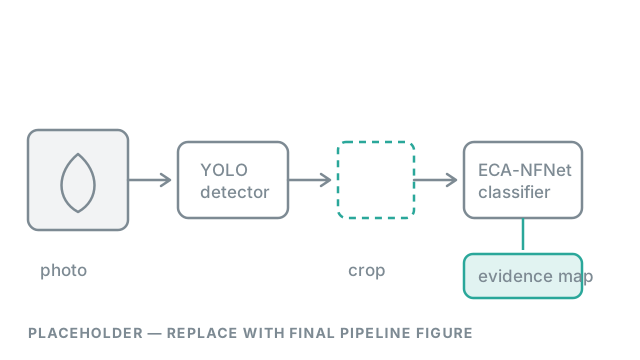
Stage 1 is a YOLO detector that localises the leaf region; stage 2 is an ECA-NFNet classifier operating on the detected crop; saliency overlays are generated for each prediction so the evidence can be visually checked against the symptoms. Cropping before classifying removes most background shortcut signals by construction.
Results
| Stage | Metric | Score |
|---|---|---|
| Leaf detection (YOLO) | mAP@0.5 | — |
| Disease classification (ECA-NFNet) | Top-1 accuracy (%) | — |
Full quantitative results, ablations, and qualitative explainability examples are in the paper; code is on GitHub.
Demo
Limitations & what I’d do next
- Benchmark-to-field gap: much of the training imagery is cleaner than real field photos; a small field-collected test set would say more than another point of benchmark accuracy.
- Stage-wise error propagation: when detection misses or crops badly, the classifier inherits the mistake. End-to-end fine-tuning of the two stages is the natural follow-up.
- The explainability evaluation is qualitative. Overlays look right to a human, but I’d want faithfulness metrics (deletion/insertion curves) before claiming the model uses the evidence it highlights.
- Per-class behaviour: rare diseases deserve a per-class error analysis, not just aggregate accuracy.